
Serenity on One Hull. Capability on Two.
Adventure is calling. Are you ready?
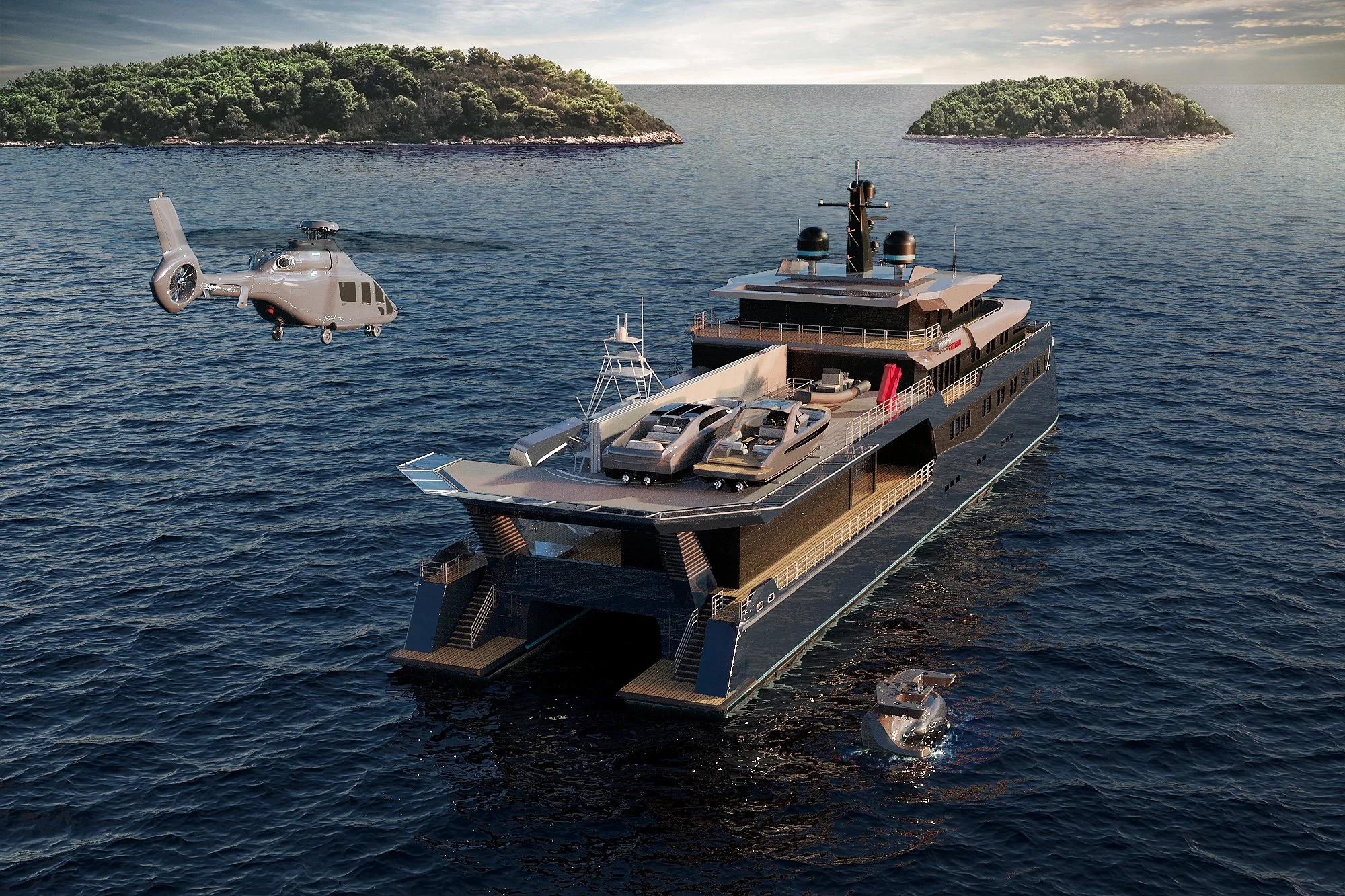
For the owner who measures a voyage by what happens off the deck rather than on it, the real limitation has never been range. It has been readiness. Remote anchorages promise possibility, yet traditional yachts arrive cautiously, balancing fuel, storage, guest comfort, and operational capability. A dedicated support vessel changes that equation entirely. The mothership becomes the place for living, while the shadow vessel becomes the platform for doing.
With a true workhorse alongside, exploration stops being selective and becomes spontaneous. Tenders remain permanently rigged and fueled. Dive gear stays assembled and dry. Water toys launch in minutes rather than being planned around deck logistics. Helicopters, submersibles, scientific equipment, and expedition vehicles no longer compete with guest areas. The program arrives prepared instead of adapting on arrival. Beaches can be set before guests step ashore. Remote coves become temporary bases. Days begin with options rather than constraints.
Design Freedom Returned to the Mothership
Just as importantly, separating capability from accommodation liberates the design of the primary yacht. When cranes, garages, workshops, fuel reserves, and heavy equipment move to the shadow vessel, naval architects and designers are no longer forced to trade experience for utility.
“Instead of allocating volume to storage and launch systems, the mothership can dedicate that same space to people.”
That freedom appears in tangible ways. A lower deck once reserved for toy garages becomes a full wellness level with spa, gym, and treatment rooms. The stern that might have been dominated by launch gear opens into a true beach club at the waterline. Upper decks gain uninterrupted sightlines without aviation or storage constraints. Noise and vibration from compressors and machinery disappear, allowing cabins to sit closer to the water. Even crew flow improves, because operational traffic no longer crosses guest areas. Owners gain not just space but atmosphere. Dining areas remain calm because staging and prep happen elsewhere. Lounges stay uncluttered because equipment lives on a separate platform. The yacht becomes intentional architecture rather than a compromise between residence and expedition base.
Why the Platform Matters
The support vessel itself is not simply additional storage. It is specialized infrastructure. And when that infrastructure is built on a catamaran platform, capability expands in ways a single hull cannot replicate.
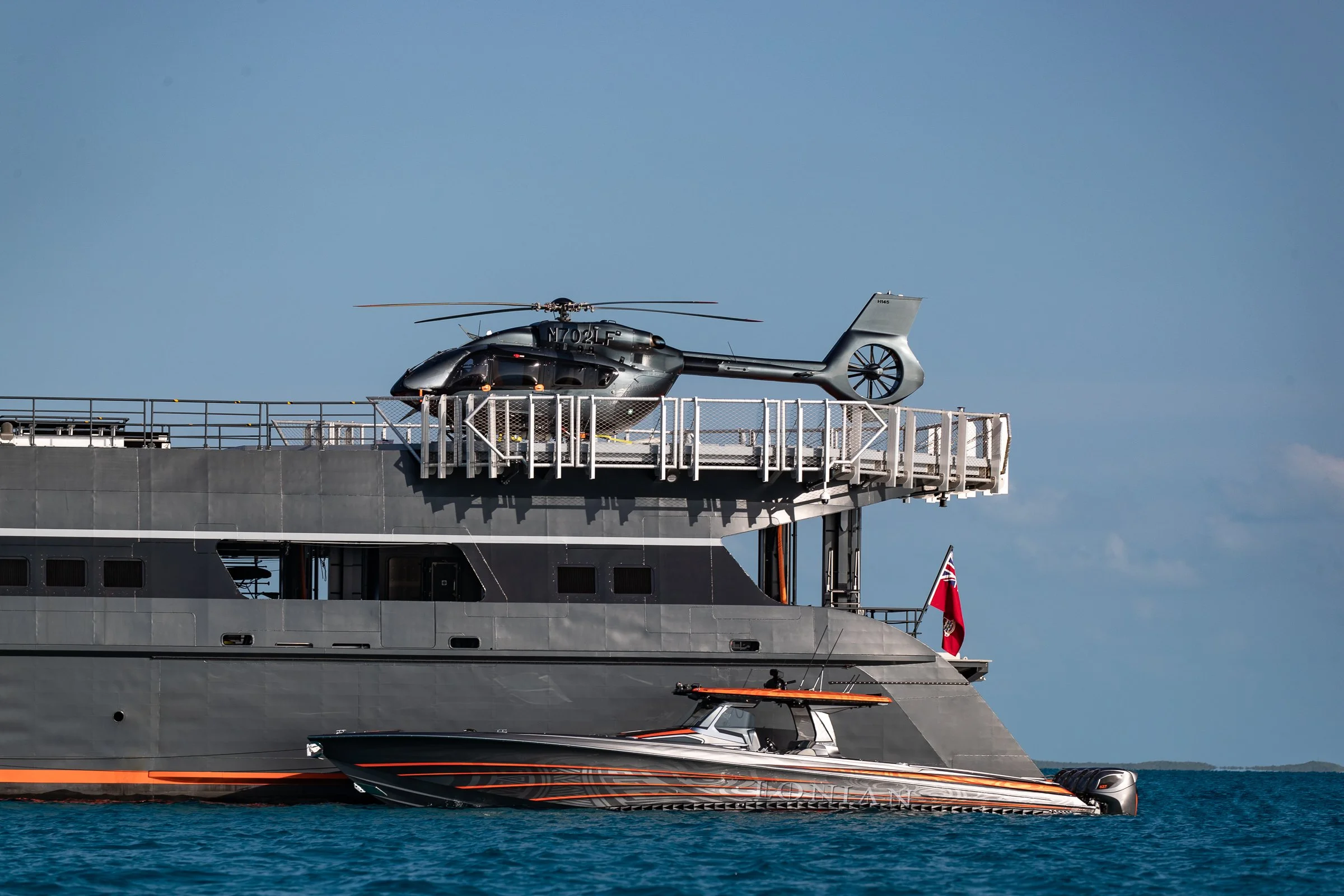
One of the clearest examples is aviation. Owners increasingly want true aviation capability rather than occasional helicopter access. A certified helideck requires clear safety zones, structural strength, and operational separation from guest areas, while a hangar demands even more protected volume. The wide stance of a catamaran provides both deck area and stability, allowing aircraft operations to remain predictable even as sea conditions change. On a monohull the landing zone competes with railings, superstructure, and motion. On a catamaran the aircraft sits within a broad working platform, making certification practical rather than theoretical. The result is not merely a landing pad but dependable aviation operations.
Handling the Equipment Modern Programs Carry
The same geometry transforms tender capability. Modern yacht programs carry increasingly specialized craft such as long range sport fishing boats, large center consoles, amphibious tenders, rescue craft, and expedition landing boats. A catamaran offers full width working deck space and vertical clearance without raising the vessel profile. Heavy cranes operate within a stable footprint, and launching happens in a controlled vertical lift instead of swinging loads over the side. When a long tender hangs off a monohull, leverage and roll moment increase rapidly, limiting both size and safety. Between the hulls of a catamaran the load remains centered and supported, so larger craft can be handled routinely rather than cautiously.
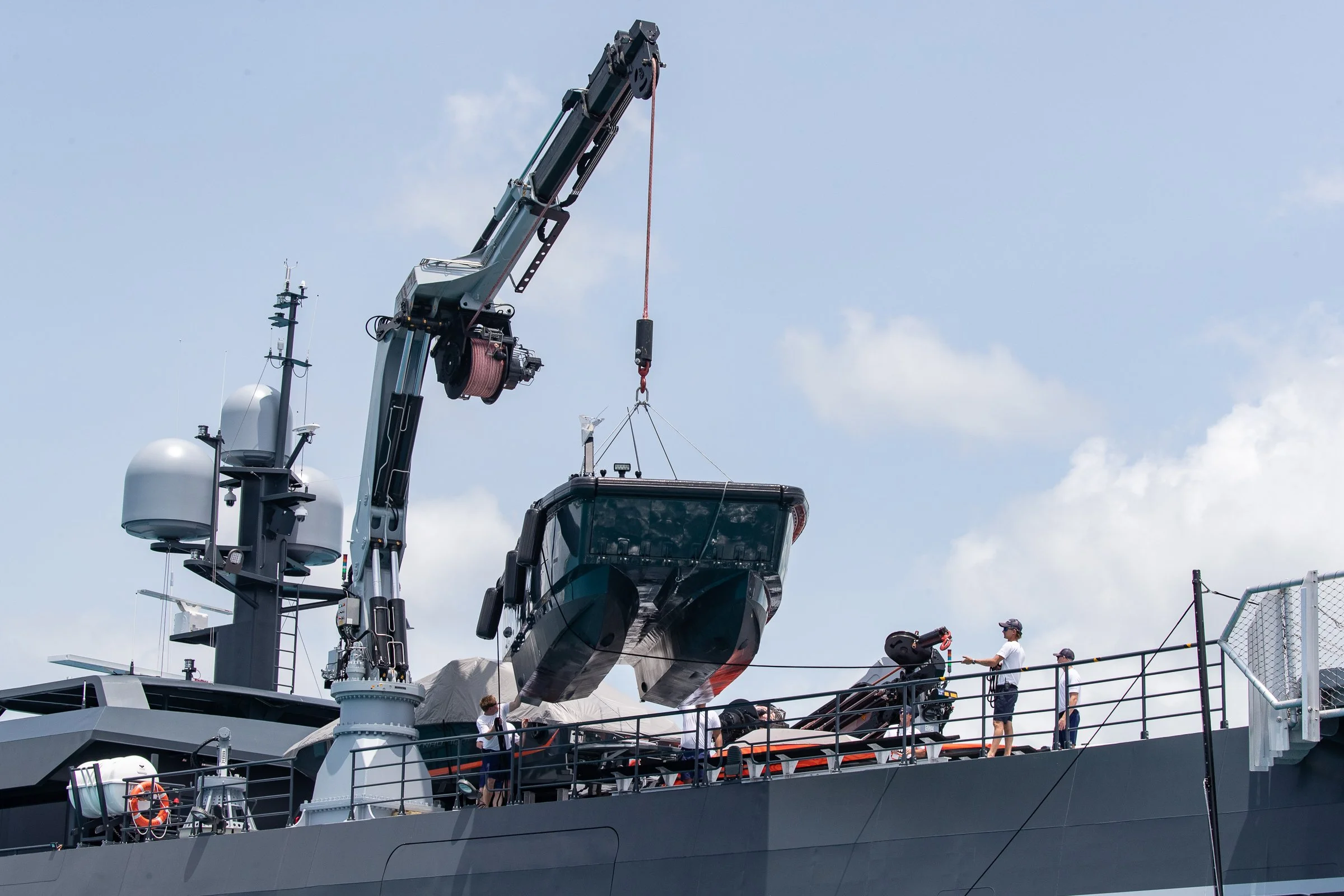
In practice this changes behavior. Launching a large fishing boat or multi passenger expedition tender becomes a repeatable operation rather than a carefully timed maneuver. Guests step aboard at water level, equipment remains fully rigged, and recovery happens quickly regardless of swell direction. The platform behaves less like a yacht and more like a shore base that moves with the program.
Two Vessels, One Experience
For adventure minded owners this reliability expands ambition. Better equipment travels because it can be deployed safely. Crews operate with confidence instead of waiting for perfect conditions. Activities grow from what might be possible to what is dependable.
In this way the two vessels work together with clear purpose. The shadow vessel carries the toys, endurance, and operational capability, while the mothership delivers comfort and connection to the surroundings. One enables activity, the other protects experience. Together they allow a yacht to do more by asking it to do less.