
When Bigger Stops Delivering More
“The tipping point is the moment of critical mass, the threshold, the boiling point.” — Malcolm Gladwell
In superyacht programs, there is a comparable threshold that the industry should start naming out loud.
For decades, the prevailing assumption has been simple: if you want more capability, you build a bigger yacht. At smaller scales, this logic holds. Increasing length delivers more volume, more range, and more flexibility. Beyond a certain point, however, that relationship begins to break down.
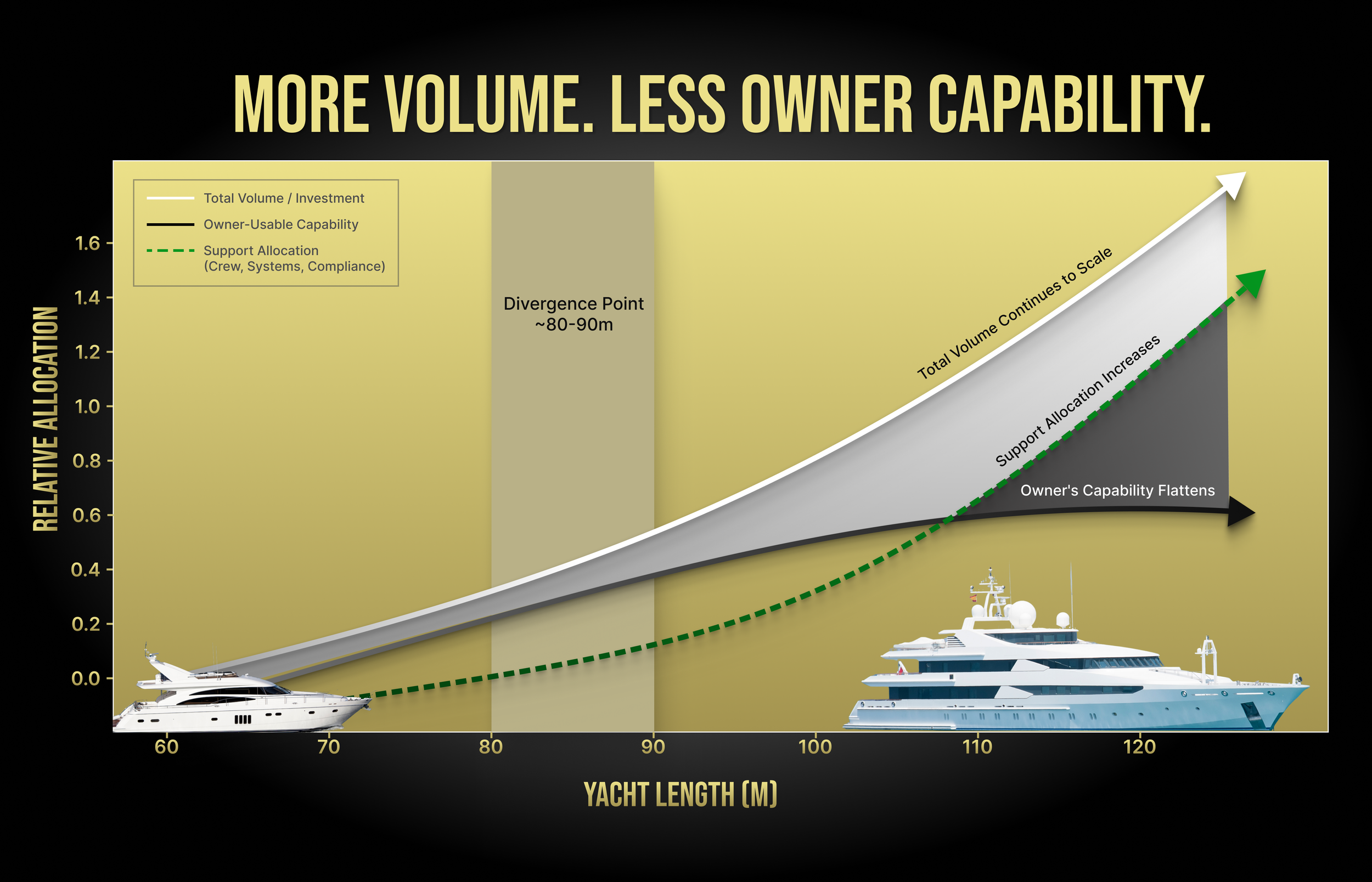
Somewhere between 80 and 90 meters, additional length stops meaningfully increasing what a vessel can actually provide for the client. Instead, the yacht becomes more complex to design, harder to build, and more difficult to operate without tradeoffs. The program can appear stronger on paper while becoming less flexible in practice.
This is the inflection point the industry rarely addresses directly.
Cost and Scale: What Theory Suggests vs What Owners Experience
In most forms of shipbuilding, larger vessels benefit from economies of scale. As size increases, we expect the cost per unit of volume, or cost per gross tonnage, to decrease. Fixed costs are spread across a larger platform, and efficiencies in production begin to take hold. At the upper end of the superyacht market, however, this effect becomes far less pronounced.
While cost per gross tonnage may stabilize or marginally improve, the total volume of the vessel increases significantly as length increases. This results in a substantial rise in total project cost, even if unit efficiency does not deteriorate.
The outcome is what many owners experience as sticker shock. Not because the vessel is inefficient on a per unit basis, but because the scale of what is being built expands faster than anticipated.
As vessels extend beyond 90m+, the relationship between size and capability begins to diverge. While gross tonnage continues to increase with added volume, a growing proportion of that space is allocated to crew accommodation, technical systems, circulation, and safety requirements rather than owner facing use.
At the same time, the areas that underpin real operational capability, particularly deck space for aviation and tender deployment, do not expand at the same rate. Additional scale introduces competing demands on space and systems, meaning that capability does not scale proportionally with size, and in many cases cannot be utilized simultaneously without compromise. Owners are paying more for each incremental increase in length, often without a proportional increase in functional capability.
The Shift Is Not About Cost Efficiency. It Is About Allocation.
The challenge at scale is not that large yachts are inherently inefficient to build. It is that a growing share of investment is directed toward:
· enabling the vessel to function
· rather than expanding what the vessel can do
This distinction is subtle, but critical. Owners are increasingly investing in the infrastructure required to sustain scale, while realizing only marginal gains in usable, owner facing capability. When considered together, these factors suggest that large yachts reach a practical ceiling in what a single platform can deliver.
Beyond the “LOA tipping point”, additional investment increases comfort and complexity, but not meaningful operational flexibility. The vessel becomes more impressive, but not necessarily more capable.
Time Becomes the Hidden Cost
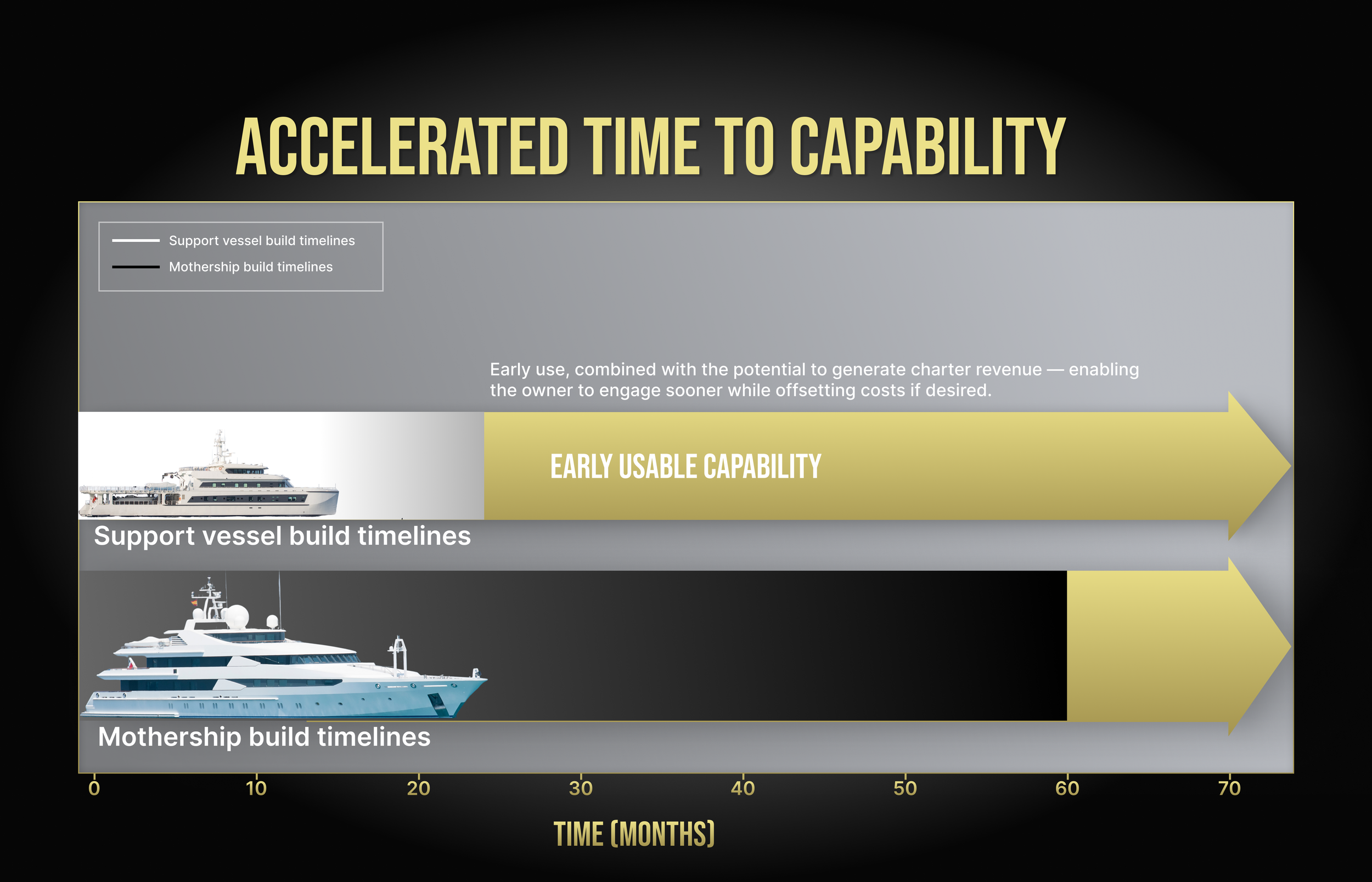
The breakdown in scale is most visible not only in cost, but in time. A 60-to-70m yacht is typically delivered in approximately 36-to-50 months. A 90m+ custom yacht often requires 4 to 5 years from concept to completion.
However, build time alone no longer defines the full timeline.
Access to shipyard capacity has become a second constraint. Leading yards are frequently booked years in advance. In practical terms, the timeline from initial decision to delivery can extend well beyond 6-8 years.
This introduces a different kind of risk. What an owner defines today as their ideal program is unlikely to remain static over that period. Owners are not just waiting longer to use what they have built. They are committing to decisions that must remain relevant nearly a decade into the future.
The Gap Between Capital and Capability
The relationship between time, capital deployment, and usable capability is not favorable in large yacht construction. The longer timeline creates a delay in access to capability, despite continuous capital deployment. This creates a widening gap between investment and usable outcome.
In a traditional single vessel program, operational value is effectively locked until completion.
Rethinking Scale
Given these factors, how can we, within the industry, more effectively advise owners?
The answer is not always more boat…it is proactively advising owners toward fleet architecture. Distributing capability across multiple platforms allows portions of that capability to come online earlier. Owners begin to use what they have built sooner, rather than waiting for completion.
Capability is more than what a vessel can deploy. Owners want to know how quickly, reliably, and simultaneously that capability can be brought into use under real conditions.
A More Effective Model for Brokers and Advisors
A distributed platform approach reframes the program around time to operational capability.It does not require giving up the idea of a mothership. It simply changes how and when capability comes online.
Instead of concentrating everything into a single 90m+ build with an extended and uncertain timeline, the program is split across platforms that can be delivered and deployed sooner. A smaller, highly capable mothership paired with a dedicated support vessel allows critical operational functions to exist independently and be used immediately.
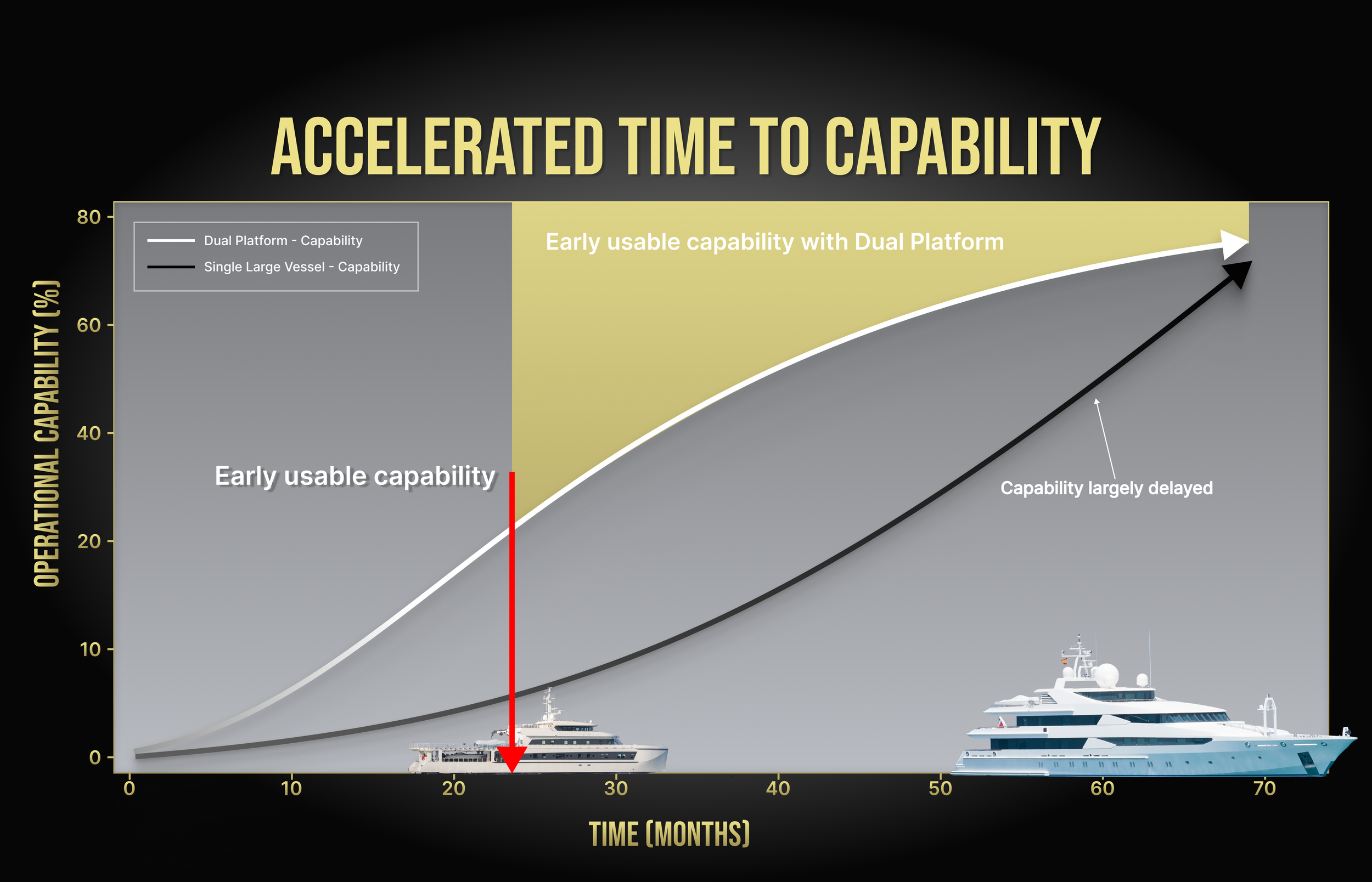
A multi-vessel program also changes what is possible during the build itself. Rather than waiting years for a single platform to deliver, a support vessel can be introduced early, bringing immediate access to aviation, tenders, and expedition capability while the primary yacht remains under construction. This creates a usable asset from the outset, not just a future one. Owners can travel, operate, and refine their program in real conditions, informing decisions on the mothership before it is complete.
At the same time, the vessel can be selectively chartered, providing a mechanism to offset operating costs and maintain activity within the asset. The result is a program that is not paused during construction, but actively in use, generating both experience and optional value from day one.
We are interested in what you are seeing on the front lines. Where are owners pushing for scale, and where are those decisions creating challenges in delivery, capability, or long-term satisfaction? Understanding these pressure points is essential if we are going to better align what is being sold, built, and ultimately experienced.
We believe that scale alone does not determine the strength of a yacht program; what matters is how efficiently capability is delivered, how early it can be used, and how effectively it translates into real world experience over time.