
What if we’ve been measuring the wrong things?
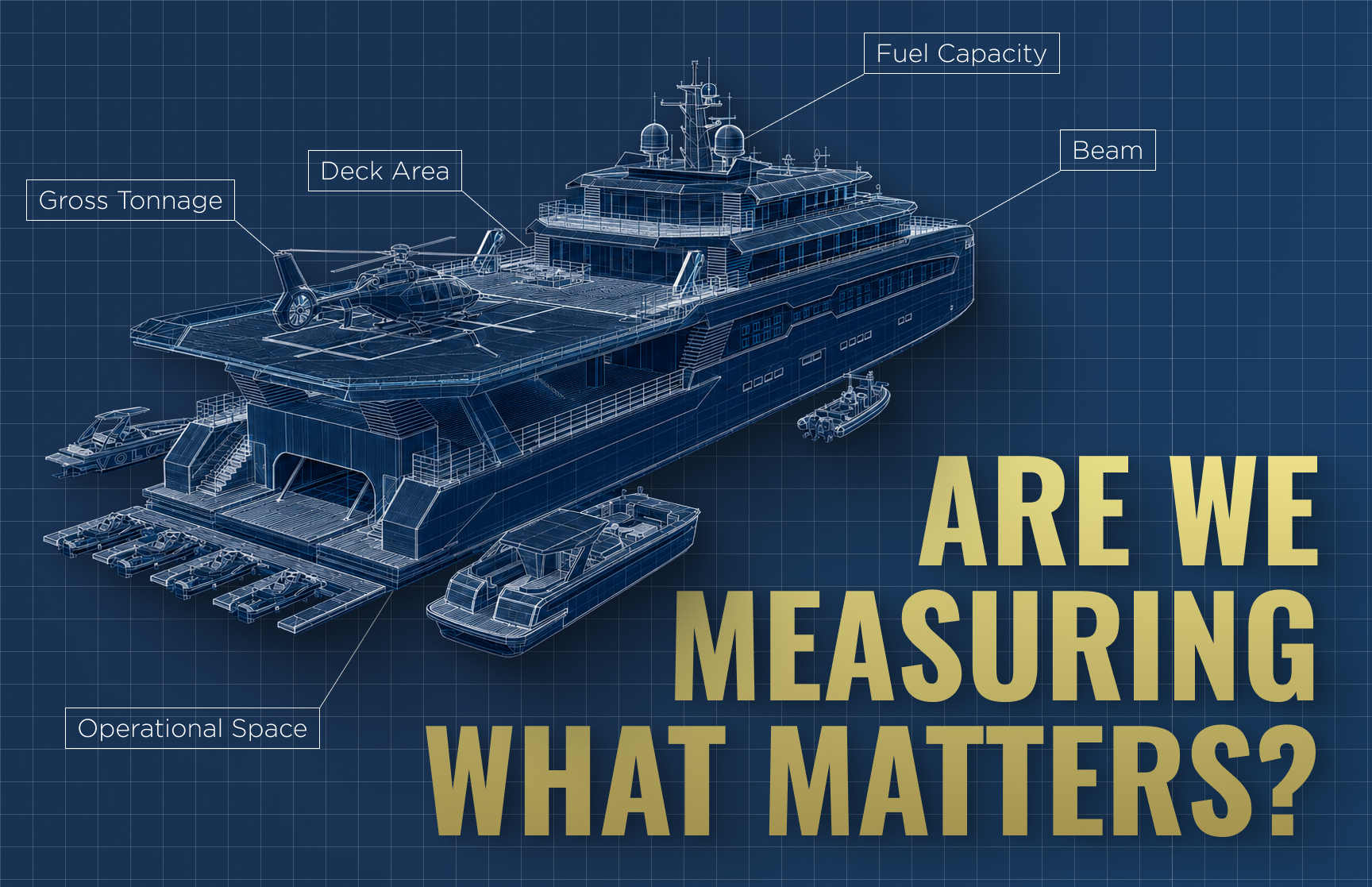
Every decision creates a new set of possibilities while closing off others. That's simply how opportunity costs work. We can't avoid giving things up; we can only decide whether we're doing it thoughtfully.
Think about a family home. A young couple may begin with a two-bedroom house. For years, it works perfectly. But life evolves. The couple has children, begin new hobbies, have more frequent family guests visit, and more. As many of us know, new priorities emerge.
Eventually, the family isn't dissatisfied with the house. They've simply outgrown the assumptions on which it was chosen.
Support vessels are no different. For decades, they have largely followed established patterns about certain lengths, certain configurations, and certain assumptions because that is what is available. Unfortunately, while the category has matured, many of those assumptions have not. We want to challenge those assumptions and highlight that accepted practice and optimal practice are not always the same thing.
If the purpose of a support vessel is to support the owner's operation, perhaps the first question shouldn't be:
"What does everyone else buy?"
Perhaps it should be: "What capability does the mission actually require?"
Capability Is Measurable

Every stakeholder in a yacht program, from owners, family offices, brokers, owner's representatives, captains, designers, technical managers to shipyards, brings preferences and perspectives to the discussion, which are often related to aesthetics, experience and convention.
Capability, however, is objectively measurable.
How much deck area is available?
How efficiently does the vessel travel?
How much useful volume is delivered?
How safely can tenders and toys be launched and recovered?
How shallow can the vessel operate?
How much capability is created per euro invested?
These are not subjective questions. The numbers exist.
Looking Beyond Length
When comparing platforms of similar size and intended purpose, the differences become surprisingly clear.
Consider a comparison between a modern 52-metre catamaran, and a conventional 53-metre monohull support vessel. While both offer capable platforms, the numbers reveal meaningful differences in how each converts size, tonnage, fuel and capital into operational capability.
None of these metrics alone tells the whole story. Taken together, however, they reveal something important:
Capability is not simply a function of length or gross tonnage. It is a function of how effectively a platform converts capital, tonnage and dimensions into utility.
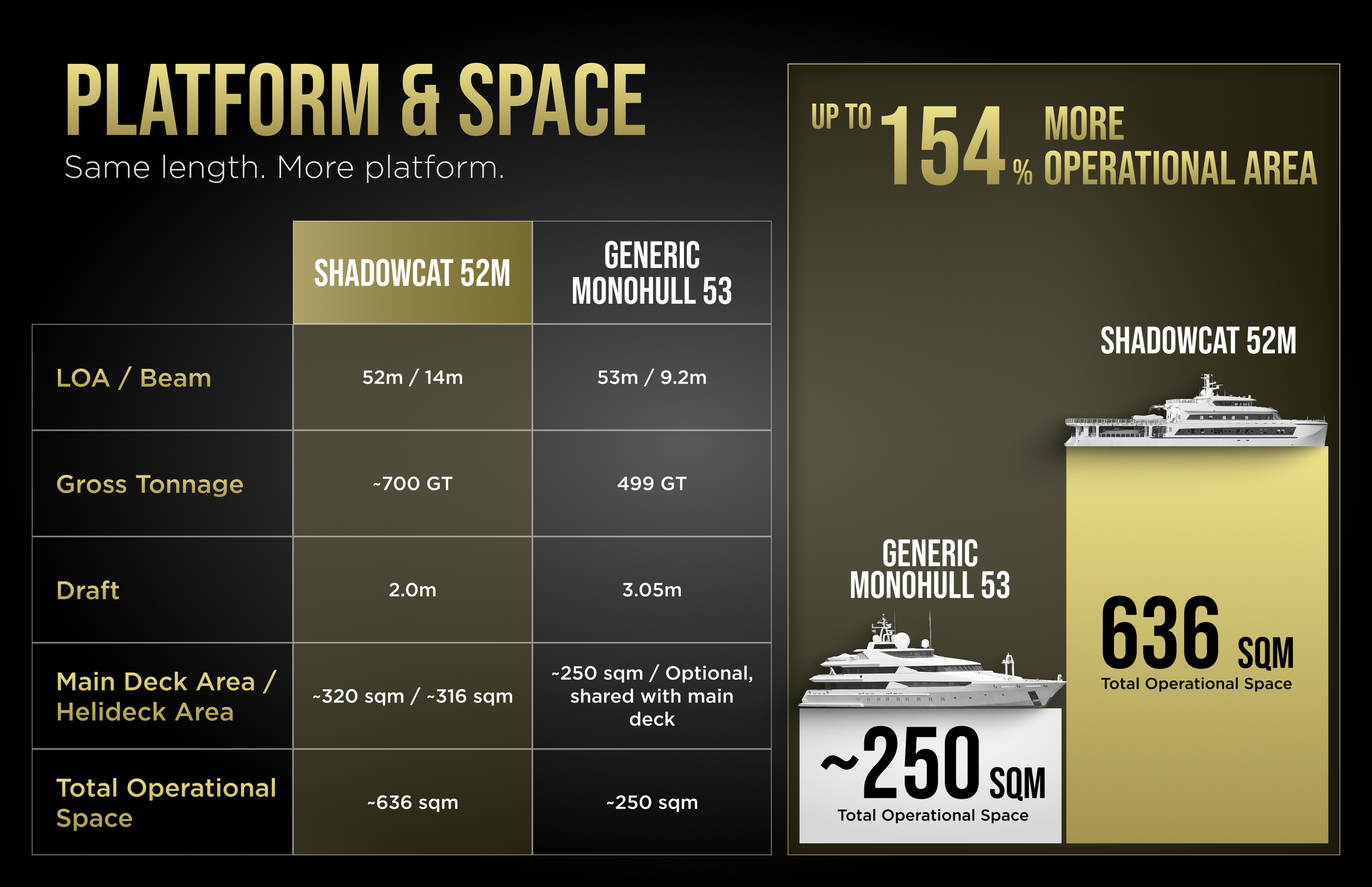
Much like two homes with the same square footage can support very different lifestyles; two vessels of similar length can deliver vastly different operational outcomes.
The Opportunity Cost Nobody Talks About
The industry spends a lot of time talking about what Owners are buying, and not nearly enough time talking about what they are giving up. Sticking with our home analogy, choosing a house with a smaller garage means giving up storage. Choosing fewer bedrooms means giving up flexibility. Choosing less land means giving up possibilities that may only become apparent years later.
Similar tradeoffs exist in support vessel design. Choosing one platform over another may mean giving up:
Deck space.
Helicopter capability.
Fuel efficiency.
Access to shallow destinations.
Storage flexibility.
Future growth potential.
Operational simplicity.
Those opportunity costs rarely appear in brochures, and yet they influence every day of the vessel's life.
Are We Optimizing for 95% of Operations or 5% of Conditions?
Support vessels spend the overwhelming majority of their lives doing exactly what they were designed to do. They launch tenders. Support helicopter operations. Carry toys and expedition equipment. Enable beach setups. Travel thousands of miles. Support guests and crew. In short, they spend most of their time delivering capability. Unfortunately, decisions about support vessels are sometimes disproportionately influenced by scenarios that represent only a small fraction of a vessel's life.
Homeowners understand this intuitively. Few people choose a house based on where they might store holiday decorations once a year. They choose based on how they live every day.
Unfavorable sea conditions are an inherent reality for any ocean-going vessel, and both catamarans and monohulls possess distinct characteristics that experienced captains learn to manage. Those occasional conditions deserve consideration, but they should be weighed alongside the thousands of routine operations that occupy the other 95 percent of a vessel's life.
If maximizing for an occasional scenario means accepting less deck space, higher fuel consumption, reduced helicopter capability, greater draft, or lower carrying efficiency every day, then those trade-offs deserve to be acknowledged deliberately.

Mission Should Dictate Platform
No platform is perfect, and every design involves trade-offs. The goal isn't to prove one solution right and another wrong. It's to understand what is being gained, what is being given up, and whether those trade-offs align with the owner's mission.
The numbers themselves are objective. Fuel efficiency, operational space, lifting capability, draft, and value per gross ton are measurable. They don't care about opinions, preferences, or what has always been done. They simply help us understand the trade-offs.
After all, mission should dictate platform, not the other way around.