
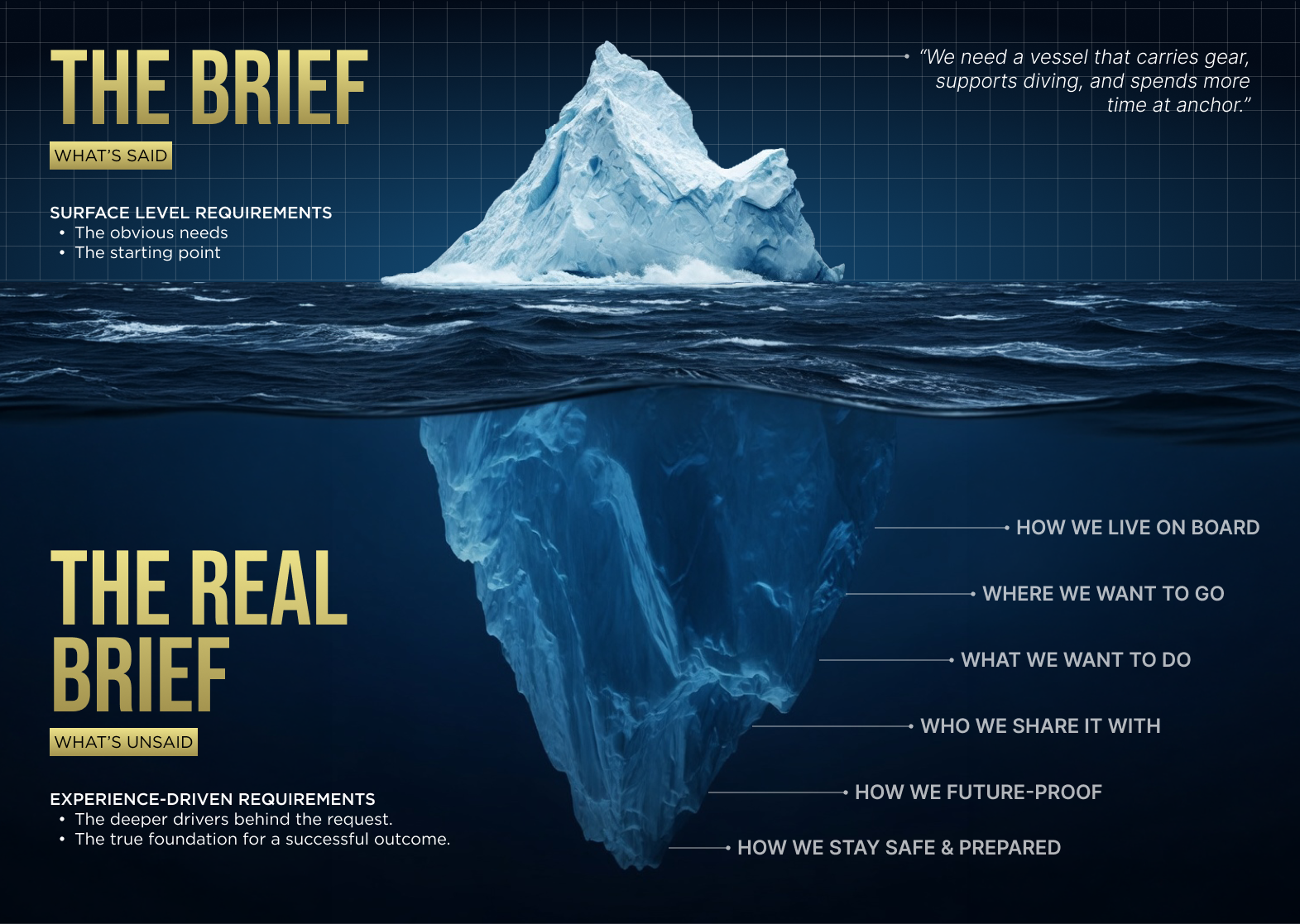
The 4 Cs: Asking Better Questions Earlier
What's the most important part of the yacht-building process? Ask ten experienced professionals and you'll probably hear the same answer:
"Get the brief right."
Everything that follows is shaped by those first conversations:
• The design.
• The engineering.
• The budget.
• The contracts.
• The operational profile.
• Ultimately, the owner's experience.
But getting the brief right isn't simply about understanding what yacht an owner wants to build. It's about understanding what they want to achieve.
Owners are pursuing increasingly sophisticated operations, but many of the decisions that define those operations are still being made too late in the process. It's not because the industry isn't asking questions. Quite the opposite.
The challenge is that no decision exists in isolation. Every answer influences another aspect of the program, revealing new considerations around capability, logistics, crewing, cost and future flexibility.
At SHADOWCAT, we've found that four simple questions consistently help bring clarity to these early discussions. They help move the conversation beyond specifications and into operational intent, creating a stronger foundation for every decision that follows.
We call them the 4 Cs.
Capability: What does the owner want to do?
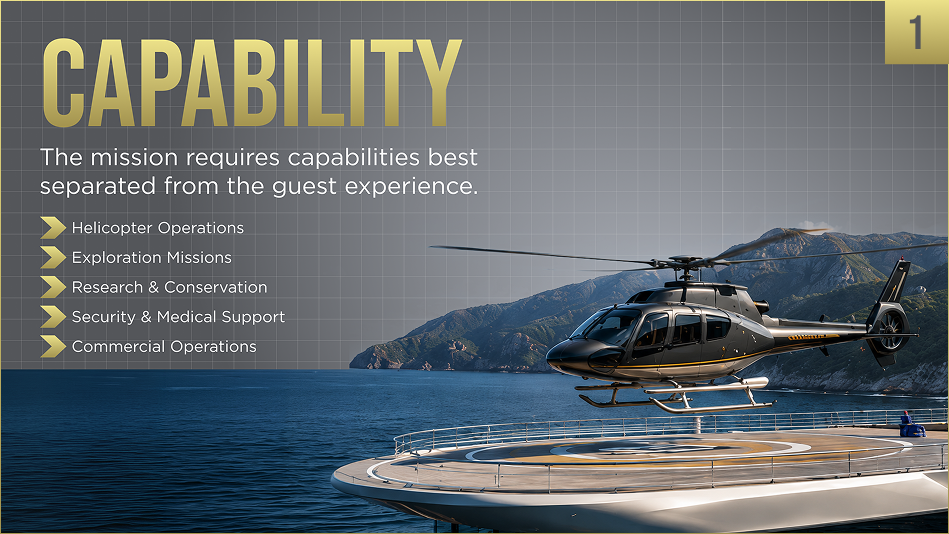
The first conversation shouldn’t be about the yacht. It should be about the mission.
Owners rarely begin by describing technical requirements. Instead, they describe the experiences they want to have: flying by helicopter, exploring remote anchorages, carrying larger tenders, diving, fishing, or hosting extended groups of family and friends.
These shouldn't be viewed as equipment requests. They're a description of the lifestyle and operational outcomes the owner is trying to achieve.
An experienced advisor recognizes that every objective carries a series of downstream implications. The goal is to understand the owner’s priorities well enough to define the capabilities the program must deliver.
This stage should define the program before it begins to define the vessel. Once the required capability is understood, every subsequent decision has a clearer purpose.
Capacity: What does that capability require?
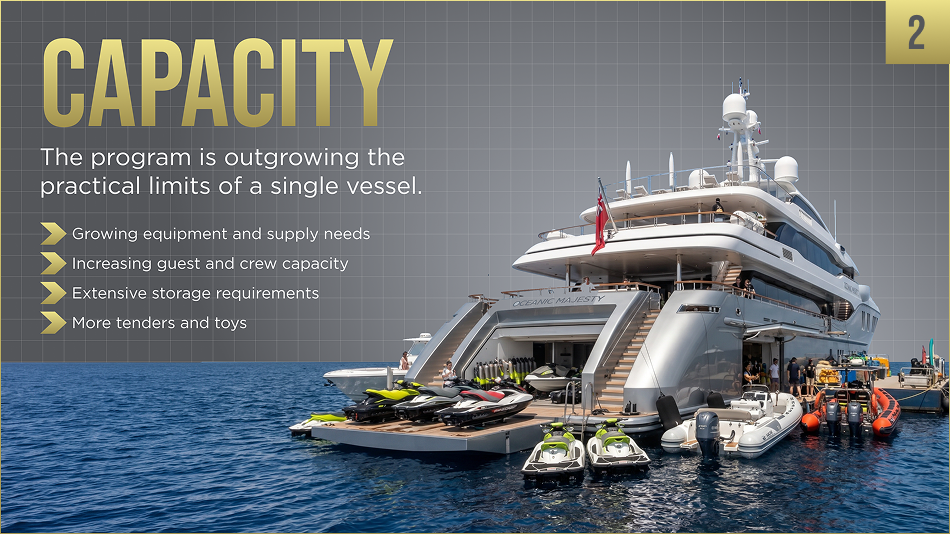
Once the desired capabilities have been established, the next step is understanding what they demand from the platform.
Every capability has a physical footprint. Helicopters require more than a landing area. Large tenders need launch systems, storage, maintenance access and fuel. Expanded toy collections demand deck space, logistics and servicing. The list grows quickly.
Capacity isn't simply a question of volume or gross ton. It's about ensuring the vessel has the space, systems and infrastructure to support the owner's intended operation without compromise.
This is where good advisors can create the greatest value. By testing the owner's ambitions against the realities of the proposed platform early in the briefing process, they preserve the freedom to optimize the entire program. Too often, however, support vessel discussions begin only after the mothership has been designed and key decisions have been locked in. What should have been a strategic conversation becomes an exercise in accommodating constraints, leaving owners to compromise on capabilities that could have been achieved had the multi-vessel program been considered from the outset.
Complexity: What does it take to make it work?
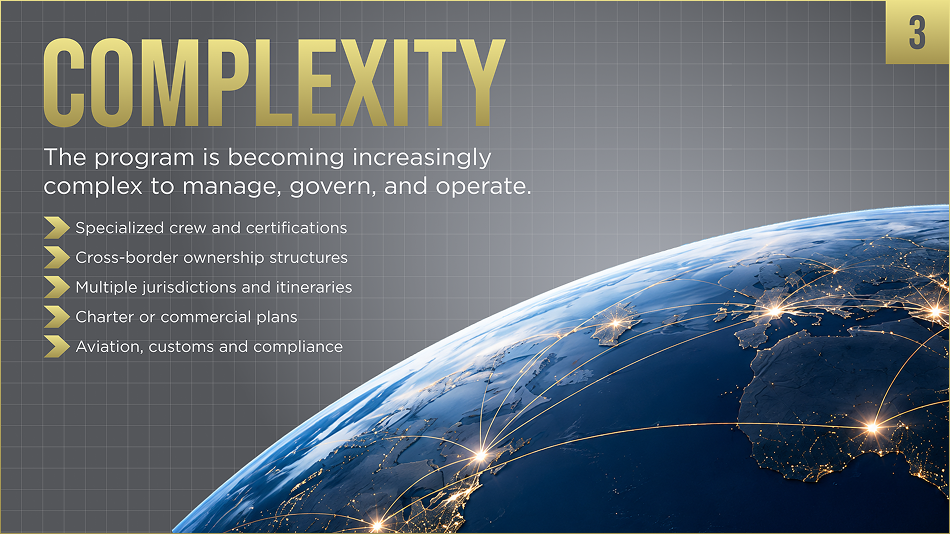
Once the required capabilities and capacity have been defined, the next step is understanding the operational complexity they introduce.
Every new capability brings additional people, procedures and responsibilities. A dive program requires trained crew, equipment maintenance and storage. Helicopter operations demand coordination, safety procedures and specialized support. Larger tenders influence launch and recovery operations, crewing and maintenance.
Complexity isn't about making an owner's ambitions seem difficult. It's about ensuring the operational model is as thoughtfully designed as the vessel itself. These conversations are most valuable during the early planning stages, when changes to the program are still relatively simple to make.
Continuity: How does the program keep working?
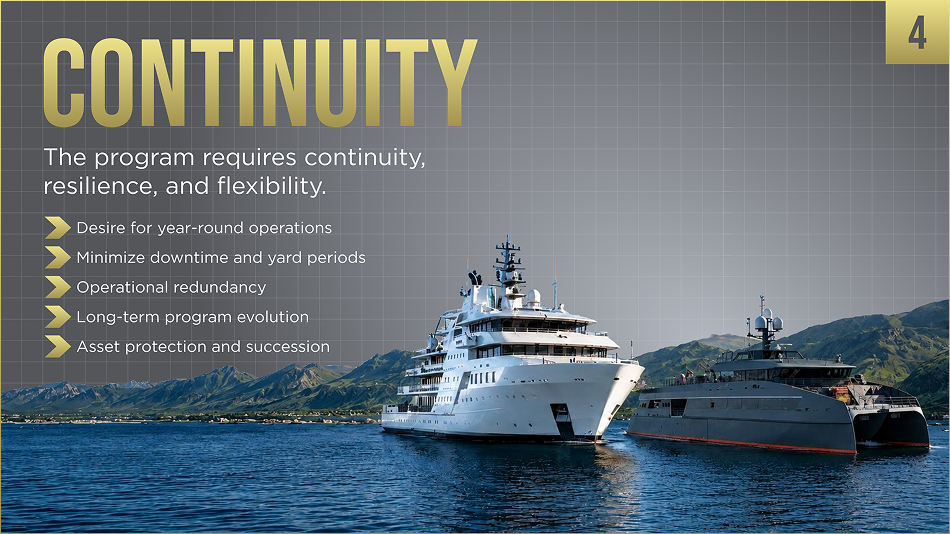
A successful yacht program measured by how reliably it continues to deliver capability and experiences over time. Owners are increasingly expecting year-round operations, greater flexibility and fewer interruptions to their time on the water. That means advisors should be thinking beyond the individual vessel and considering the resilience of the entire program.
How will operations continue during refit or scheduled maintenance? Is there enough redundancy to avoid cancelling an owner's plans if a critical system is unavailable? Can the program evolve as new interests, technologies or family priorities emerge? Is the owner's investment structured to support long-term value and succession planning?
These aren't questions that can be answered by adding more equipment to a single yacht. They require a broader view of the owner's operation. Continuity is about building a program that remains capable, adaptable and resilient over time.
By working through Capability, Capacity, Complexity and Continuity at the outset of a project, the owner's brief evolves from a list of desired features into a long-term operational strategy. The team is designing a program. One that can support the owner's ambitions today while remaining flexible enough to evolve with them in the future.
Building Better Briefs Through Better Questions
At its core, the 4 Cs are an active listening framework. When an owner talks about helicopters, larger tenders, dive operations, expedition cruising, scientific research, carrying more toys, or spending longer periods away from marinas, they aren't simply describing equipment. They're describing an increasingly sophisticated operation.
Those moments should prompt a different conversation.
Rather than asking, "How do we fit all of this onto the yacht?" advisors should begin asking, "Is this becoming a multi-vessel program?"
Too often, support vessels are introduced only after the mothership has been largely defined, forcing owners to compromise on capabilities that could have been delivered more effectively through a purpose-built support platform.
Early engagement creates the opportunity to evaluate the program as a whole, not just the mothership. In many cases, a smaller, more efficient yacht paired with a dedicated support vessel can deliver significantly greater operational capability than attempting to incorporate every function into a single, increasingly complex superyacht. Comparing the capital and operating costs of these two approaches early in the process often leads to very different conversations, and, ultimately, better-informed decisions.
The role of a trusted advisor isn't to recommend a support vessel in every case. It's to recognize when the owner's ambitions suggest that one should be part of the discussion.
That's why we developed the 4 Cs.
It's a simple framework designed to help brokers, owner's representatives, captains, technical managers, family offices and other advisors translate an owner's aspirations into a more complete operational brief—one that considers not only the yacht, but the entire program needed to deliver the experience they envision.
To help make these conversations easier, we've also created a downloadable 4 Cs Advisor Cheat Sheet. Feel free to save it, share it with colleagues, or keep it nearby as a reference during early client discussions. Sometimes, asking one better question at the right moment is all it takes to change the direction of an entire project.