
As yacht programs become larger and more sophisticated, the relationship between size, capability and investment becomes increasingly nuanced. Comparing a representative two-vessel program to a single 120-meter yacht, Jennifer Johnston Smith, SHADOWCAT Co-Founder and Commercial Director, explores how capital investment could be converted into operational capability.
Over the past few weeks, thousands of owners, brokers and advisors will have toured the world's largest yachts. It is easy to be captivated by scale – standing alongside a 120-meter yacht, the instinct is to assume that everything has become larger and therefore better. Beneath the surface, however, lies a more interesting question: How much of the owner's investment is creating capability and how much is simply making the yacht larger?
Here, we explore that question and attempt to illustrate what different investment strategies actually deliver.
Defining the question
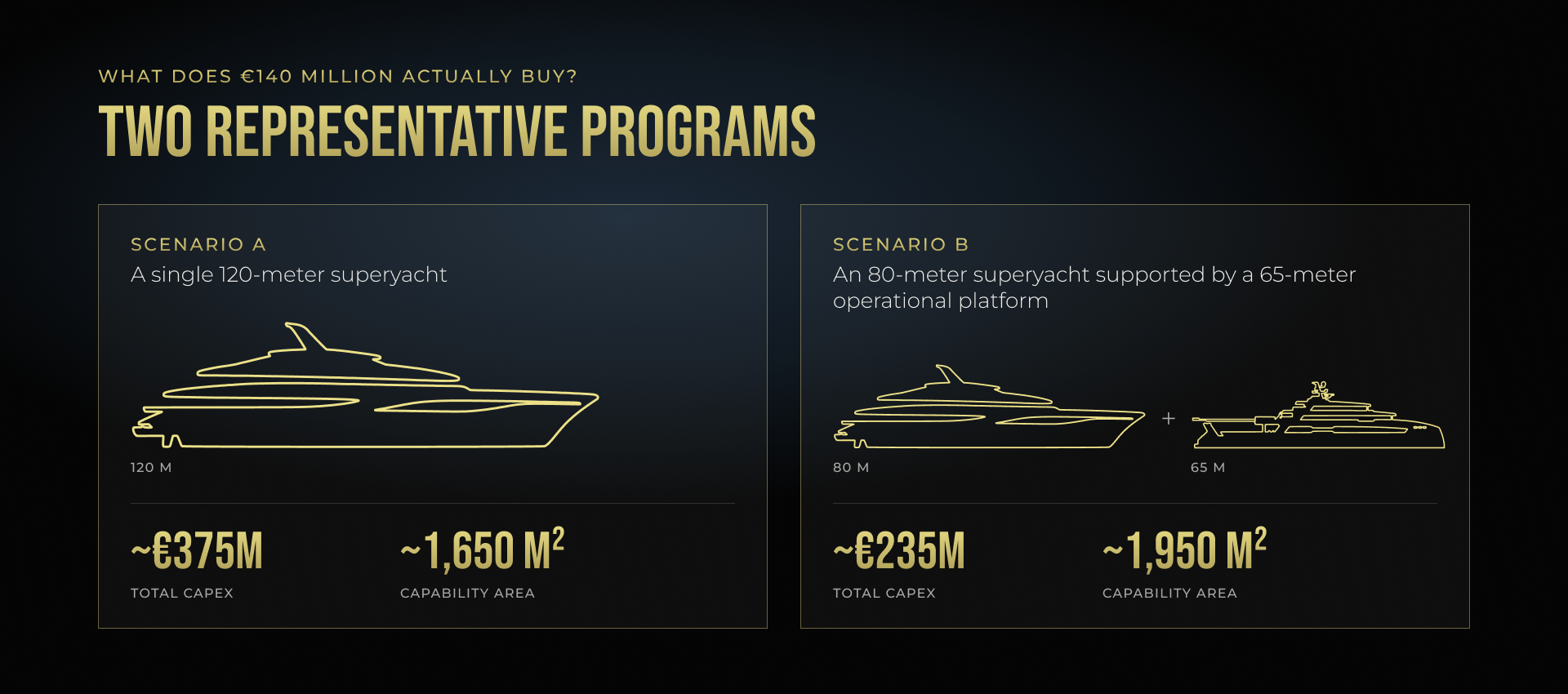
For this exercise, we compared two representative programs:
Scenario A: A single 120-meter superyacht.
Scenario B: An 80-meter superyacht supported by a 65-meter operational platform.
Both programs are intended to support sophisticated private cruising with aviation, large tenders, toys, expedition capability and extended operations. The objective was to understand how effectively each program converts capital investment into operational capability, not to advocate one program over another.
Establishing the assumptions
Like any effective comparative analysis, this study begins with a transparent set of planning assumptions. We did not intend to define a 'typical' 120-meter yacht or suggest that every owner's brief should allocate space in the same way. Instead, we developed representative planning models based on published general arrangement drawings, publicly available technical specifications, current market observations and common design practices observed across large custom yachts and support vessels.
Some planning inputs, particularly the operational capability area, vary significantly depending on how an owner intends to use the vessel. A hospitality-focused yacht, for example, will allocate substantially more space to guest amenities than one designed around aviation, expedition support or scientific operations. Rather than treating any single value as universally correct, we established representative planning ranges for those variables and selected midpoint values to create a consistent basis for comparison.
Other assumptions, including representative build costs and annual operating expenses, were also selected as planning-level midpoints. These figures are not intended to predict the final cost of any individual project. Instead, they provide a transparent framework for evaluating how different program architectures convert capital investment into operational capability. The goal is to ensure consistency within the model's comparative relationship between the two programs.
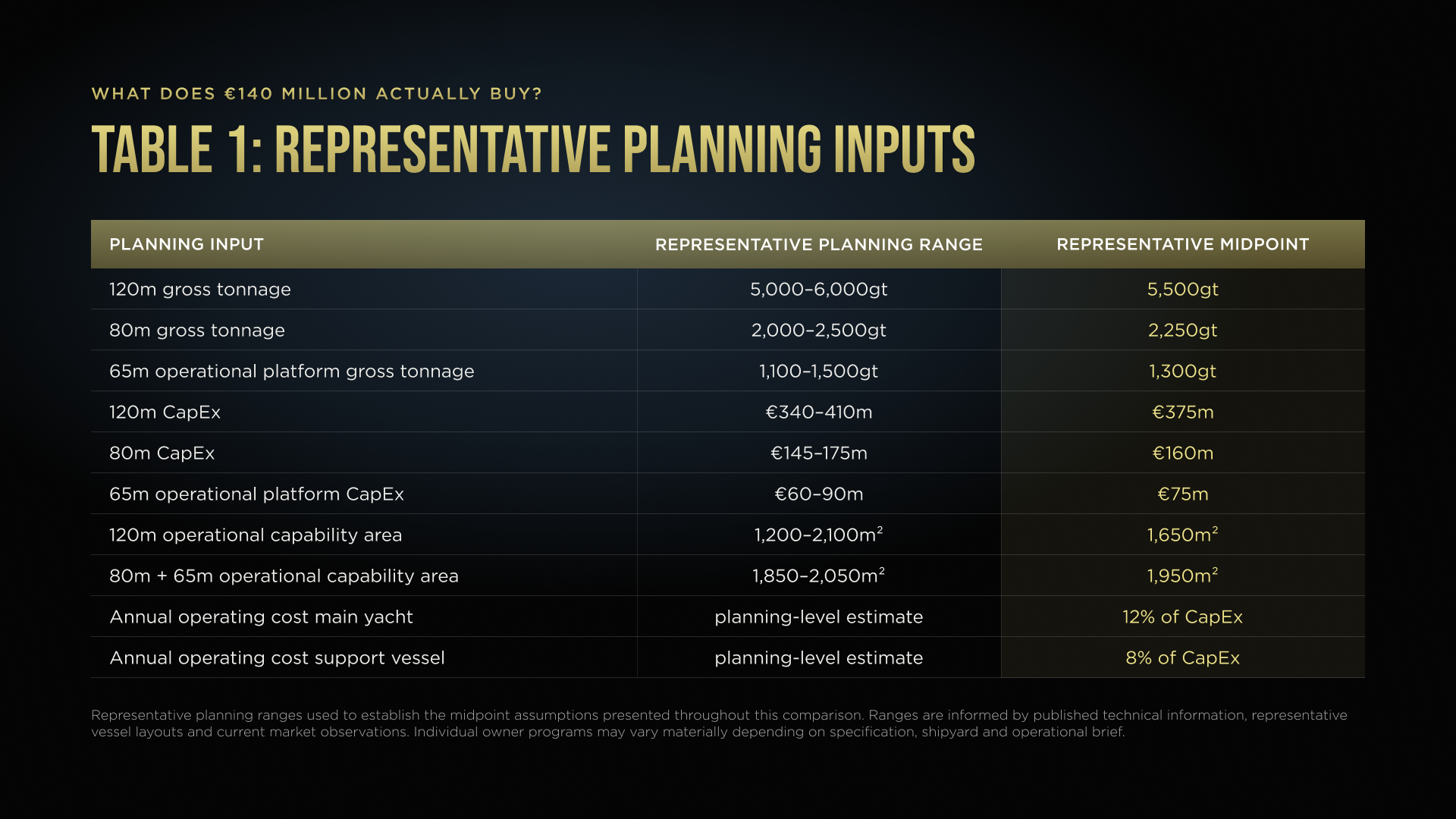
Representative planning ranges used to establish the midpoint assumptions presented throughout this comparison. Ranges are informed by published technical information, representative vessel layouts and current market observations. Individual owner programs may vary materially depending on specification, shipyard and operational brief.
Measuring capability
In "Are We Measuring What Matters?", we suggested that traditional metrics such as length and gross tonnage don't always reflect the experiences owners are trying to achieve. This analysis takes that idea one step further by comparing programs based upon mission infrastructure.
To do this, we are introducing the concepts of 'operational capability area' and 'capability density'. Operational capability area includes spaces that directly contribute to operating the owner's program.
These include:
Tender garages and deployment areas
Helicopter landing and hangar facilities
Dive centers
Toy storage
Workshops
Logistics and provisioning areas
Crew support for operational activities
Beach club support functions
Mission decks and cargo handling areas
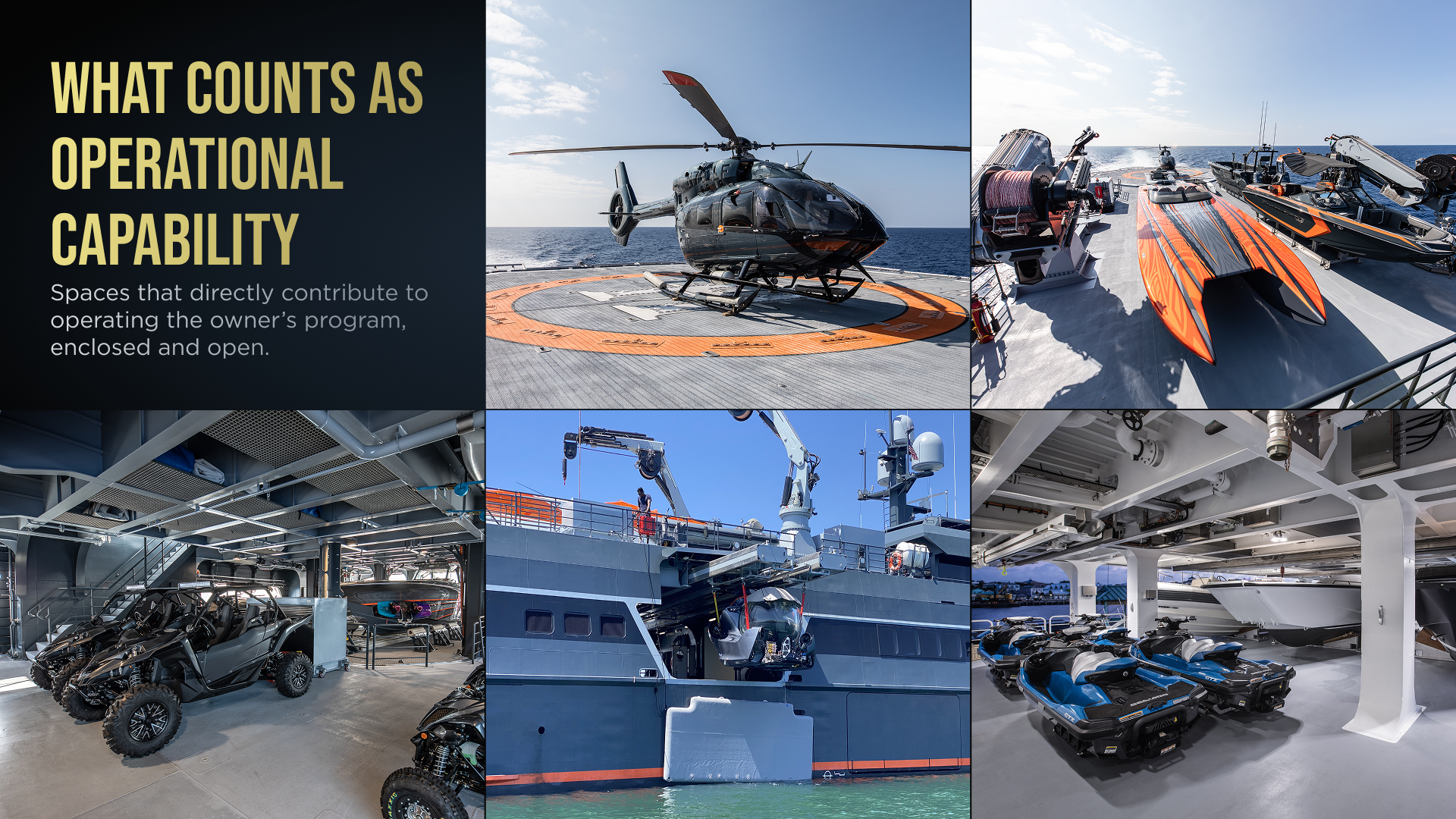
Importantly, it also includes enclosed operational spaces rather than considering open deck area alone. We want to avoid unintentionally understating the capability available aboard larger yachts with substantial internal garages and support facilities.
Conversely, guest hospitality spaces, including sun decks, lounges, pools and dining areas, were excluded because they contribute to owner comfort rather than operational capability.
Introducing capability density
In addition to operational capability area, we have included capability density as another way to represent how many square meters of operational capability are achieved for every €1 million invested.
Capability density = operational capability area ÷ total CapEx
While not every square meter has identical value, we believe this metric does provide a consistent way to compare how efficiently different program architectures convert capital into usable operational infrastructure.
What the comparison suggests
Using the representative planning assumptions outlined in this analysis, a few interesting observations emerge.
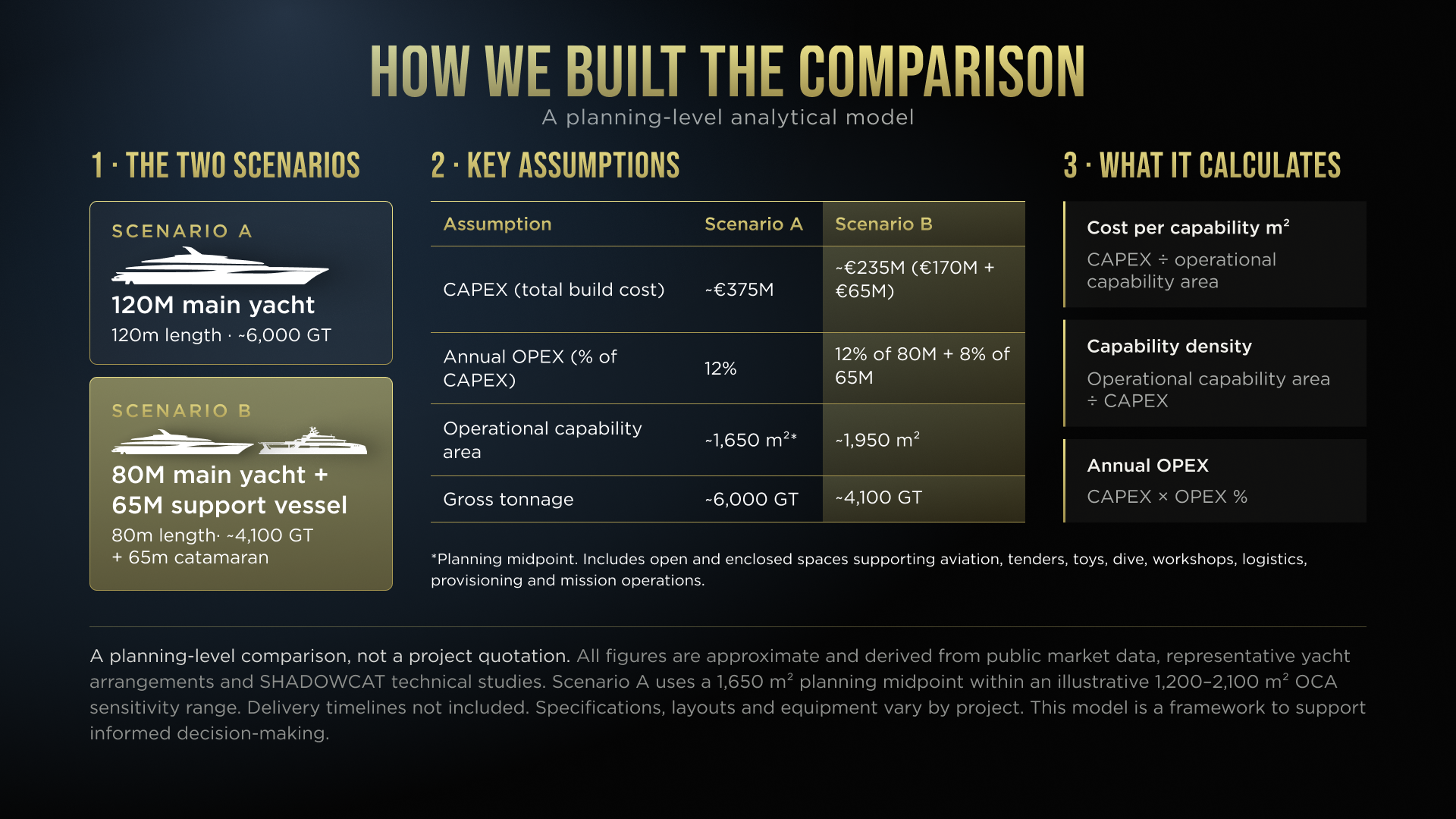
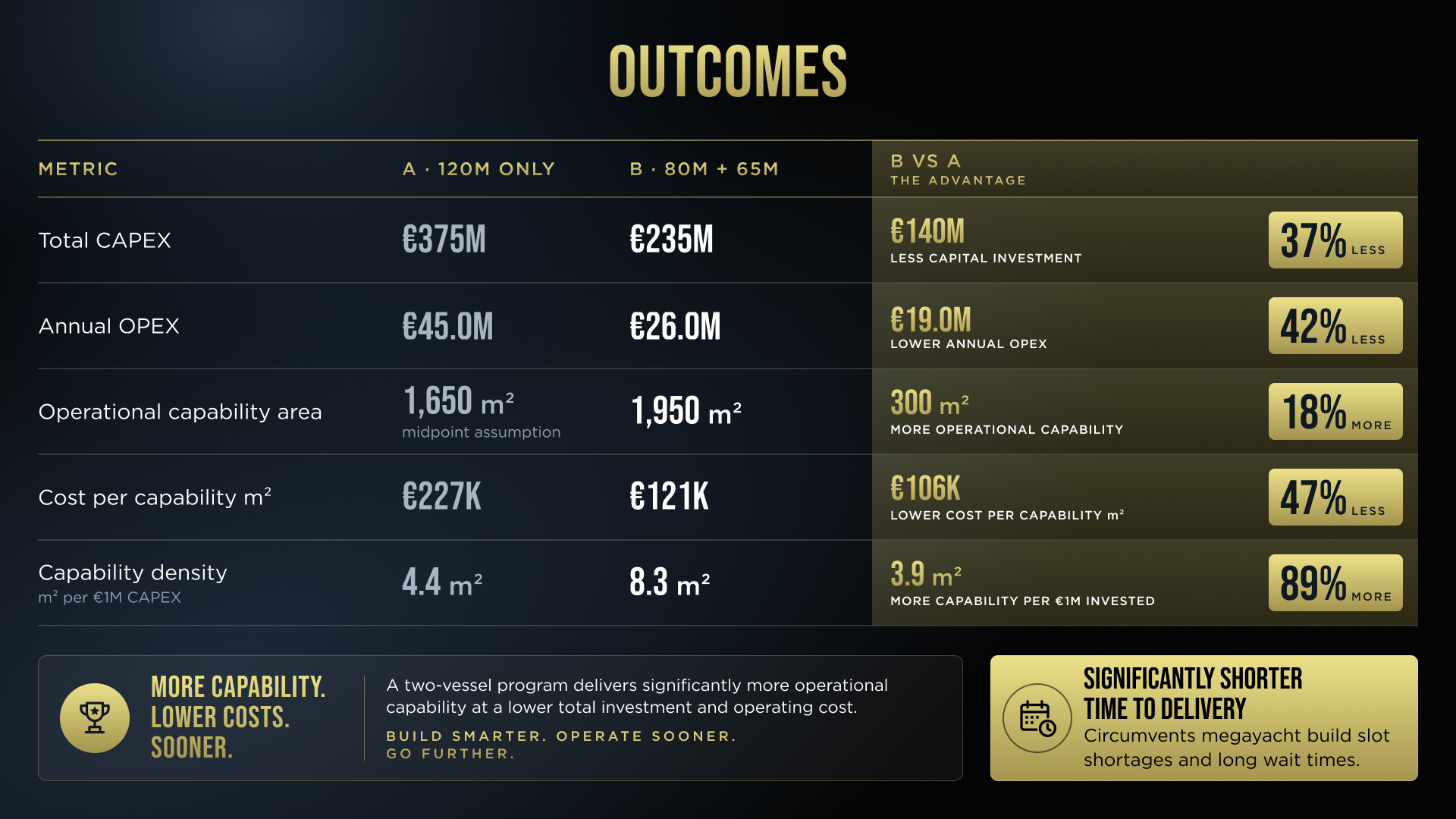
Compared with the representative two-vessel program, moving to a single 120-meter yacht required approximately:
€140 million of additional capital investment
Approximately €19 million of additional annual operating cost
Approximately 89 percent higher capital cost per square meter of operational capability area
Using the representative planning midpoint of 1,650 m² for the 120-meter yacht, the two-platform program also delivered approximately 300 m² more modeled operational capability area. As the accompanying sensitivity analysis below will demonstrate, that figure will naturally move up or down depending on how an individual owner chooses to allocate space within the yacht. Some programs will prioritize hospitality and guest experience, while others will devote more space to aviation, logistics or expedition capability.
Same investment, different priorities
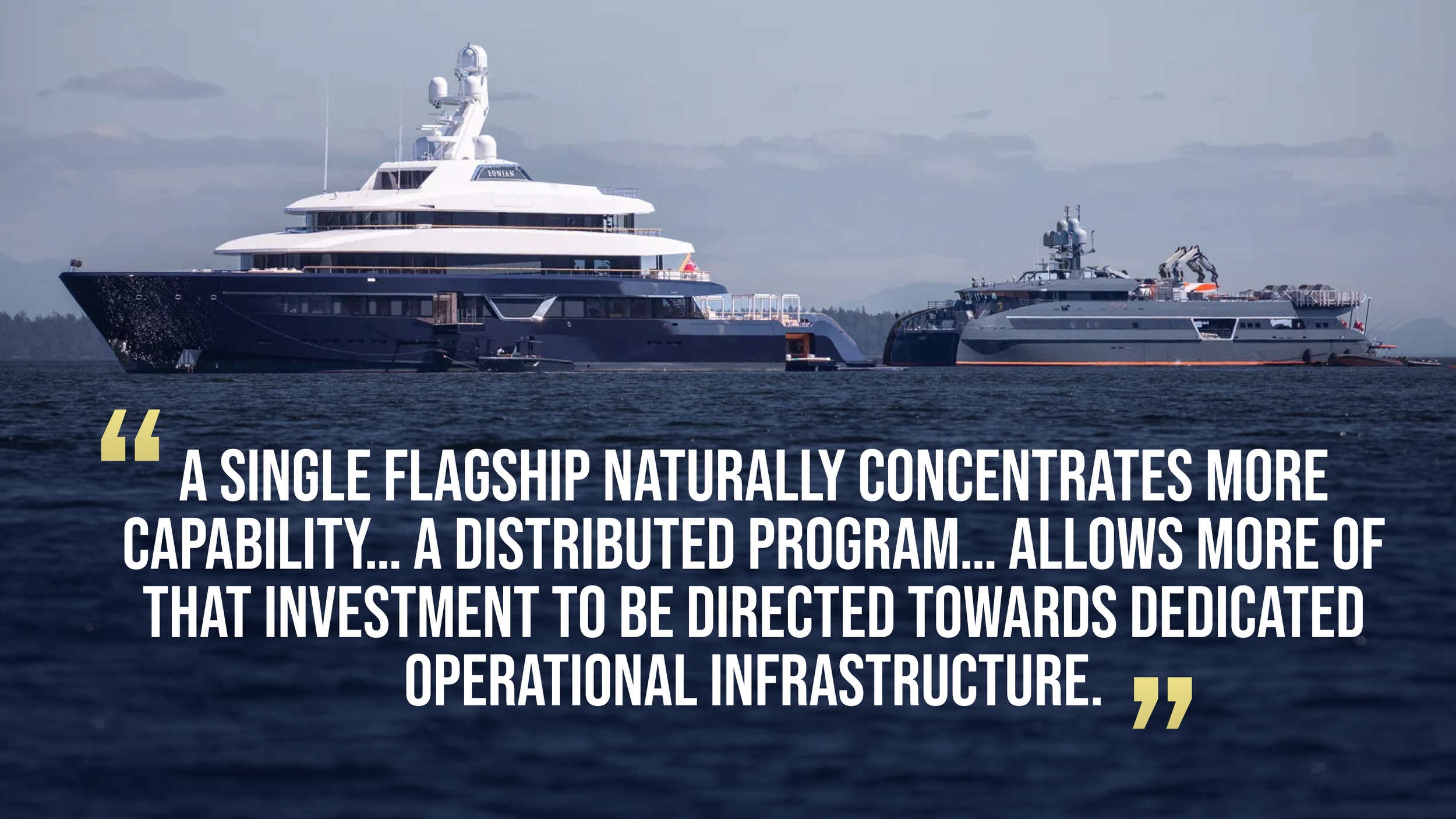
Perhaps the more interesting observation isn't that one approach outperforms the other, but that different architectures spend the same investment in very different ways. A single flagship naturally concentrates more capability, hospitality and guest experience within one platform. A distributed program, by comparison, allows more of that investment to be directed towards dedicated operational infrastructure. Neither approach is inherently right or wrong, they simply reflect different priorities.
Testing the assumptions
Because no planning model can represent every owner's program, we broadened our analysis across the full range of representative operational capability assumptions established in this study. Even when generous assumptions are made regarding the operational infrastructure aboard a 120-meter yacht, the comparative relationship changes only gradually. The amount of operational capability varies, as expected, but the broader observations regarding investment allocation remain consistent.
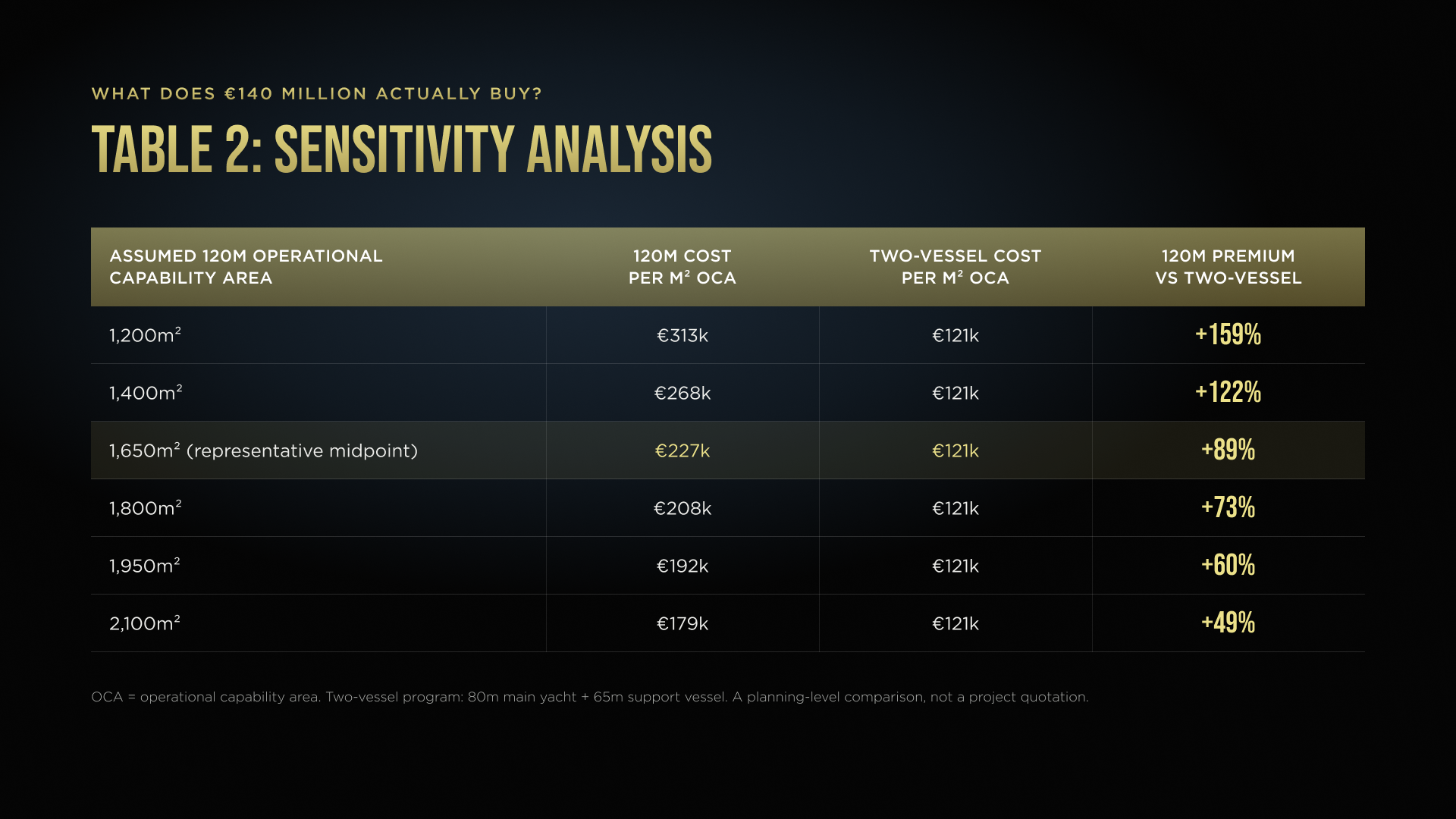
More importantly, the exercise demonstrates that there is no universally 'correct' amount of operational infrastructure for a yacht of this size.
A hospitality-focused yacht, an expedition yacht and a science-focused platform may all occupy similar overall dimensions while allocating their internal volume in very different ways. The sensitivity analysis demonstrates that changing those assumptions influences the scale of the comparison, but not the value of the discussion. Rather than relying on a single planning figure, it shows how different program architectures allocate investment toward different owner priorities across a realistic range of possible programs.
Designing the right program
This comparison was never intended to identify a universally 'better' program based on operational capability. For some owners, the simplicity, prestige and seamless experience of a single flagship vessel will represent exactly the right solution. For others, flexibility, specialization and the ability to evolve capability over time may lead to a different architecture. Both approaches are capable of delivering extraordinary experiences, they simply prioritize different outcomes.
Perhaps that's the real insight from this exercise. As yacht programs become larger and more sophisticated, the relationship between size, capability and investment becomes increasingly nuanced. The question is no longer simply "How large should the yacht be?" but rather: "What are we trying to achieve, and what combination of platforms is best suited to deliver that experience?"
For some owners, the answer may be a single, highly integrated flagship. For others, it may be an ecosystem of complementary platforms, each optimized for a specific role. Neither approach is inherently superior. The right solution is the one that best aligns with the owner's ambitions, operating style and long-term objectives.
A planning-level comparison, not a project quotation. All figures are approximate and derived from public market data, representative yacht arrangements and SHADOWCAT technical studies.
Originally published in The Superyacht Report, Refit Focus, Issue 231.